
Back to the AGI Connections Index
AGI Connections - Spring 2026
Explore AGI Federation Activities in the Latest Issue of AGI Connections
The newsletter highlights AGI news and upcoming events from across the geoscience federation. Help us share important geoscience events by contacting Geoff Camphire, AGI Communications.
In This Issue
- New Directory of Geoscience Departments App Applauded
- ‘Join Us in Geoscience Enterprise Rising’
- Earth Science Week Enhances Access with Online Resources
- Congressional Fellow Offers Geoscience Perspective in DC
- Groundwater and Soil Contamination Database Thrives
- New from AGI
- Geoscience Event Calendar
New Directory of Geoscience Departments App Applauded
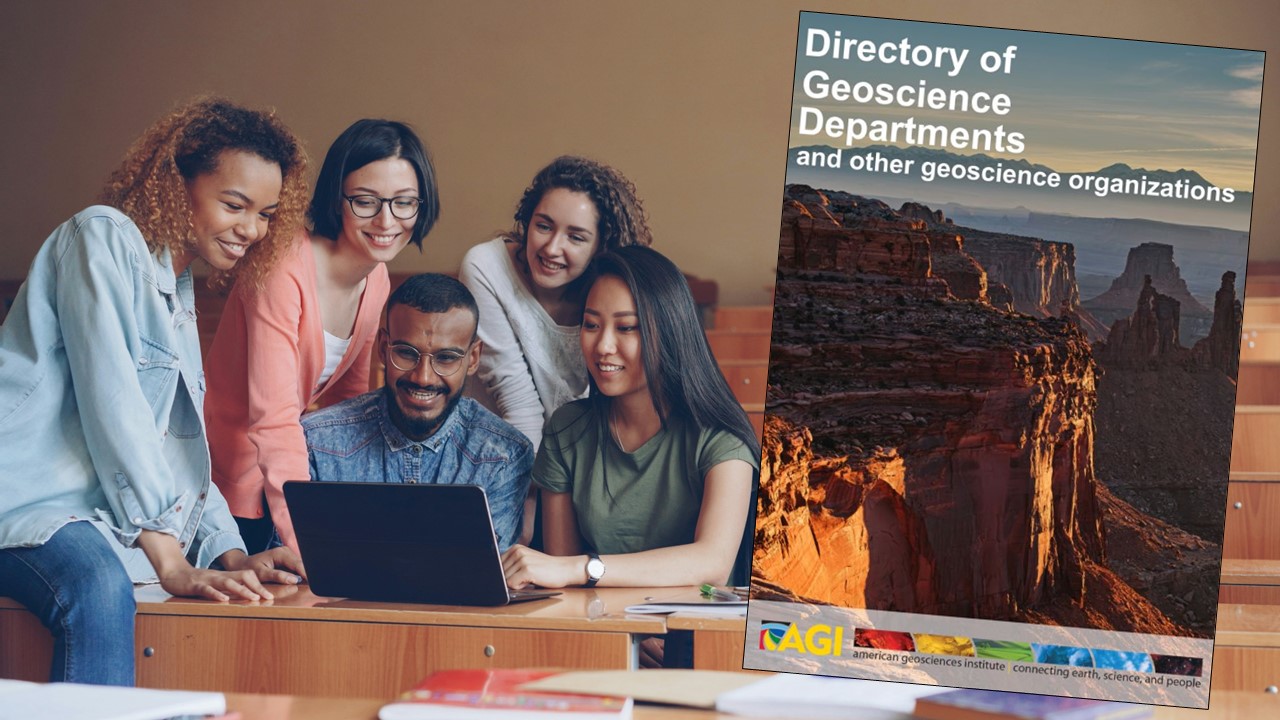
Geoscience community leaders are singing the praises of AGI’s Directory of Geoscience Departments (DGD), the most comprehensive resource of geoscience programs and organizations worldwide, now available as a web-based application. The DGD covers over 1,900 academic geoscience departments around the world, including details on individual faculty, such as research interests and contact details. It is an invaluable resource for individuals working in the geosciences or must identify or work with specialists on the issues of earth, environmental, and related sciences and engineering fields.
“The DGD makes it possible for someone to search for people and schools with specialties that they want to connect with for education, mentorship, or collaboration,” says Howard Harper, Executive Director of SEPM (Society for Sedimentary Geology), an AGI Member Society. “Having this directory online should be a big help to everyone, but especially students for their next school and early-career people trying to build a network.”
The value of the DGD goes beyond its usefulness as a compendium of contact information. “There’s a lot of rich detail that can be really useful to those of us doing research in the geosciences,” says Anne Egger, Executive Director of the National Association of Geoscience Teachers, another AGI Member Society. “I’ve worked with AGI to use DGD data to compile email addresses, reach people, and get a large response for our National Geoscience Faculty Survey. Other researchers have used the directory to conduct research and look at the number of professors in a department, or the subjects taught in a department, or to do network analysis of where people went to school and where they obtained positions.”
With the DGD app, finding potential collaborators, identifying potential advisors, and understanding the strengths of individual programs is at the tip of your fingers. After 60 years of publishing the DGD in print editions, AGI has shifted to a web-based service to lower the cost to users and provide updates on a quarterly basis to better capture the dynamic changes occurring within the academic community.
For more information, visit https://www.americangeosciences.org/products/dgd. If you are interested in site licensing, please contact AGI’s John Rasanen at jr@americangeosciences.org. To learn more about the DGD and similar efforts, contact AGI Geoscience Profession and Higher Education Director Christopher Keane.
‘Join Us in Geoscience Enterprise Rising’
A Message from Jonathan Arthur, Executive Director, AGI
The building blocks of our world depend on geoscience, from energy, water, and critical minerals to hazard resilience, robust infrastructure, national security, and economic competitiveness. Right now, the enterprise that sustains them all is at risk. Workforce pathways are thinning as retirements accelerate. Student enrollment is declining. Critical data systems are aging. Too often, policy decisions move forward without the full weight of geoscience insight. At the very moment demand for Earth science expertise is surging, our capacity to deliver it is under strain.
This is not a distant concern but a defining moment. That is why AGI is launching Geoscience Enterprise Rising, a bold, coordinated framework to strengthen, modernize, and elevate the geoscience enterprise at the scale this moment demands. For more than 75 years, AGI has served as the connective tissue of the geoscience community, bringing together over 250,000 geoscientists across more than 60 professional societies. In a field often fragmented across disciplines and sectors, AGI serves as the trusted, neutral convener aligning people, data, and ideas to serve society. Now, that role is more essential than ever.
Geoscience Enterprise Rising strategically targets the systemwide challenges that limit the enterprise while unlocking new pathways for impact. It invests in the future workforce, expands education and public engagement, strengthens policy integration, modernizes research and data infrastructure, and builds stronger collaboration across academia, industry, and government. At the same time, it accelerates the programs that already deliver value every day, from the nearly five-million-record GeoRef database to Earth Science Week’s nationwide reach, from workforce intelligence to trusted policy support.
The question is not whether geoscience matters. The question is whether the geoscience enterprise will rise to the challenge of the current moment ― intentionally, collectively, and at scale. AGI is committed to leading that effort, because the future we are building depends on the science beneath our feet. I invite you to learn more at Geoscience Enterprise Rising.
Earth Science Week Enhances Access with Online Resources
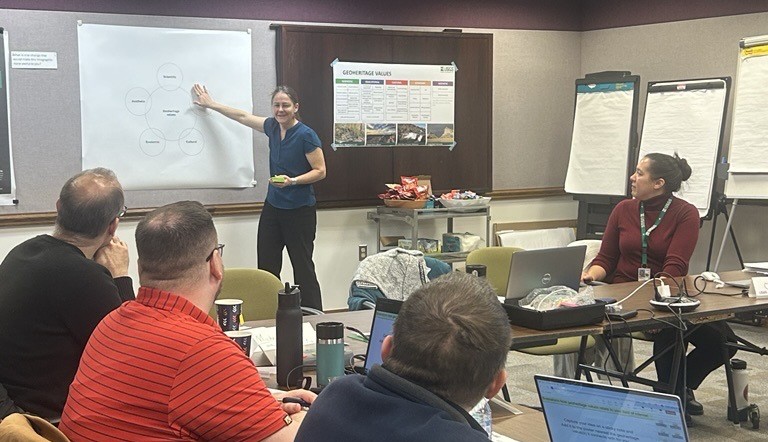
As classrooms change, so does Earth Science Week, the annual celebration of geoscience organized by AGI. With educators increasingly seeking digital tools, the AGI Education & Outreach Department has made a strategic push to expand online options and transform the program into a year-round, globally accessible resource hub. The Earth Science Week Online Toolkit curates high-demand items from past toolkits and theme-related collections, such as workbooks, guides, calendars, posters, infographics, diagrams, puzzles, board games, StoryMaps, and more. The Education GeoSource Database offers an even greater collection of thousands of education resources, including activities and curricula, professional development, standards alignment, virtual field trips, videos, assessment tools, funding opportunities, and more. Earth Science Week Classroom Activities provide a focused cache of hundreds of geoscience activities, categorized by grade level and science standards. Earth Science Week Webinars feature dozens of presentations inspired by yearly themes, such as 2025’s “Energy Resources for Our Future.” And Past Earth Science Week Resources offer a deep archive of theme-based materials from prior years, including posters, activities, and timely resources relating to innovation, visualizations, geoheritage, sustainable development, and educational strategies.
Earth Science Week partner organizations ― spanning government, nonprofits, and industry ― are seeing tangible benefits, from increased visibility to stronger engagement. For the U.S. Geological Survey (USGS), for instance, Earth Science Week is a powerful amplifier for public-facing geologic data. Christopher S. Swezey, Program Coordinator of the USGS National Cooperative Geologic Mapping Program (NCGMP), said that collaboration has been key to promoting awareness and use of The National Geologic Map Database, which is the official archive of geologic maps of the United States. He pointed to a standout example: the poster for Earth Science Week’s Geologic Map Day, which featured a new national geologic map of continental resolution on the front and educational activities developed by AGI on the back.
“Typically, The National Geologic Map Database gets about 200,000 unique users per month,” Swezey said. “After this map went live, and assisted with publicity by AGI, the database got 800,000 unique users per month. So that’s a four-fold increase.” The bigger story is how NCGMP geologic maps are reaching new communities, from geotechnical engineers to real estate and insurance professionals, plus everyday users looking up their own farms, homes, and cities. “The association with AGI has been wonderful for us,” Swezey said. “We hope to continue working together for many, many more years to come.”
For the Society for Exploration Geophysicists (SEG), an AGI Member Society, ESW is a way to extend real-world geoscience into classrooms and communities, especially by reaching students before interest fades. Annabella Betancourt, SEG Managing Director of Programs, underscored the long-term value of partnership in terms of how the SEG EVOLVE Program, which emphasizes geoscience solutions for the world’s energy needs, aligned with Earth Science Week’s energy-related theme in 2025. SEG EVOLVE, funded by the SEG Foundation, was featured through online resources, and an activity developed for the Activity Calendar.
“What I thought would be great to do was a collaboration to generate some activity sheets that will allow us to extend our reach to the K-12 program so we can get started with the kids early on and not lose the spark of geoscience once they’re past curiosity about dinosaurs, which happens around fifth grade,” Betancourt said, emphasizing the importance of relatable pathways and additional outreach events. “Our outreach program works through our student chapters, inviting college students to connect with the K-12 area and the community about what geosciences is, why it is important, and how they’re making an impact. When K-12 students see college students doing this work, they see it as relatable.”
Seequent is a global software company that is evolving the way mining, civil engineering, energy, and environmental organizations work with a better understanding of the underground. The company uses Earth Science Week to help educators access its free, web-based 3D learning tool, Visible Geology. Seequent’s contribution focuses on something educators ask for, namely interactive digital tools that make geology easier to visualize and teach. Working with AGI, Seequent developed four dedicated lesson plans, showcased in a webinar and other online forums, in which students build and manipulate 3D geological models, bringing concepts like stratigraphy and faulting to life.
“Seequent partnered with Earth Science Week to help reach and inspire the next generation of geoscientists through Visible Geology,” said Holly Chapman, Team Lead for Customer and Channel Marketing at Seequent. “Enrollments in earth science programs are declining, while the current professional workforce continues to age. There are not enough geoscientists coming through the system to meet future demand.” The benefit has been measurable, she said: “By including these lesson plans in Earth Science Week Toolkits and showcasing them in an Earth Science Week webinar, we were able to reach thousands of earth science educators around the world.”
Another longtime partner, the National Park Service (NPS), plays a central role through National Fossil Day, co-hosted with AGI during Earth Science Week. A web-based approach makes it easy for the public to participate from anywhere. Online engagement includes virtual ranger programs, online fossil exploration resources, downloadable coloring books and classroom activities, and a social media campaign using the #NationalFossilDay hashtag that expands the reach of fossils education beyond park boundaries while reinforcing stewardship and preservation. NPS also partners with the Paleontological Research Institution (PRI), another AGI Member Society, to promote fossil stewardship and paleontology education, with classroom activities like “Awesome Fossils” hosted online and widely used during Earth Science Week. The virtual fossil collections compiled by NPS and PRI also are highlighted in “Fossil Friday” reels posted on the Earth Science Week Instagram account.
“The NPS Paleontology Program has enjoyed a close partnership with AGI for more than a quarter-century,” said Vincent L. Santucci, NPS Senior Paleontologist (retired). “In 2009, the NPS and AGI ventured into establishing National Fossil Day, a partnership to promote the scientific and educational values of fossils. National Fossil Day was integrated into Earth Science Week during the second Wednesday each October. In addition to giving birth to National Fossil Day, AGI has supported dozens of fossil-related projects that have helped the NPS advance the stewardship and science related to fossils preserved in the national parks.”
Learn more online about Earth Science Week online and additional programs of AGI Education and Outreach. To discuss how AGI can and your organization can work together to support geoscience education , contact AGI Education and Outreach Director Ed Robeck.
Congressional Fellow Offers Geoscience Perspective in DC

What happens when cutting-edge climate science steps out of the lab and into the halls of Congress? For Dr. Christopher M. Sala, the answer is simple: impact. Dr. Sala is the 2025-2026 William L. Fisher Congressional Geoscience Fellow. The AGI fellowship places a geoscientist directly inside the U.S. Congress for a full year, working as staff in a congressional office or committee, to ensure science has a seat at the policymaking table.
For Sala, that seat is in Senator Jacky Rosen’s office, where he serves on the energy, environment, and public lands team. It’s a role that blends science, strategy, and public service in ways few careers can. “Coming straight from academia,” Sala explains, “I can help provide technical expertise on issues that the senator’s office may require more assistance on.”
Just months before arriving in Washington, D.C., Sala earned his Ph.D. in Meteorology, Atmospheric Science, and Climate Science from The Pennsylvania State University. His doctoral research focused on how land and ocean processes influence extreme summertime precipitation across the Midwest and Southeast ― work with real-world implications for water resource management, disaster prevention, and climate resilience.
That expertise is now being applied in real time to national decision-making. Because Senator Rosen sits on the Senate Commerce, Science, and Transportation Committee, Sala’s portfolio spans a wide range of geoscience-related topics, from federal research on weather and climate to funding of the National Science Foundation. His days might include writing internal briefings on weather modification and solar geoengineering or outlining the importance of sustained funding for an integrated ocean observing system.
Sometimes, Sala says, the job is about answering questions. Other times, it’s about asking the right ones. “I can leverage my geoscience connections to bring up issue areas that members of Congress may not be aware of that require congressional help,” he says.
For Sala, this fellowship is more than a resume milestone. It’s personal. “The intersection of science and policy has always interested me,” he says. “This opportunity grants me VIP access to the decision-making processes influencing the scientific community.”
He’s also clear about the bigger picture. Without scientific voices in government, the risks are real: missed opportunities for geoscience and society. “The geosciences must be at the table,” Sala emphasizes. “When the government forgets the important discoveries that the geosciences have provided to America over the past 100 years, then the opportunities to expand geoscientific research dwindles and valuable scientific institutions become underfunded.”
Each year, AGI’s Fisher Fellow joins more than two dozen other scientists and engineers for an intensive orientation program on the legislative and executive branches, organized by the American Association for the Advancement of Science (AAAS), which also guides the placement process and provides educational and collegial programs throughout the year. Learn more online about the Fisher Congressional Geoscience Fellowship. For more information, contact AGI Geoscience Profession and Higher Education Director Christopher Keane.
Groundwater and Soil Contamination Database Thrives
If your work touches groundwater, soil, or environmental risk, AGI’s Groundwater and Soil Contamination (GSC) database may be an indispensable resource. Launched in the late 1990s in response to rising demand for environmental data, GSC has grown into a robust, highly focused bibliographic powerhouse. Today, it contains more than 192,000 references covering global research in geology, hydrology, and environmental science. And it’s not slowing down.
GSC adds about 300 new references each month, with more than 4,000 new entries added in 2025 alone. The database is updated weekly, ensuring subscribers have access to the latest research and reports as they become available. Coverage spans more than 2,500 journals, proceedings, and report series from over 100 countries, with a strong emphasis on U.S. publications. Whether you’re researching aquifers in Arizona or remediation strategies in Germany, GSC delivers worldwide coverage with practical precision.
The specialty database is an ideal solution for those who need targeted environmental geoscience research without requiring full access to the broader GeoRef, the world’s most comprehensive bibliographic database of the geosciences. The database covers:
- Sites: soils, groundwater, aquifers, wetlands, unsaturated zones.
- Contaminants: heavy metals, hydrocarbons, pesticides, radon, radioactive isotopes, sewage, waste disposal, organic compounds, and more.
- Processes: pollution, remediation, reclamation, leaching, solute transport.
- Health and impact areas: environmental chemistry, civil engineering, economics, and public health.
What’s more, GSC makes research intuitive and efficient with keyword searching for fast topic discovery, map-based searching using geographic coordinates entered by indexers, direct links to available full-text articles, and complete bibliographic records, including ISSNs, publishers, and web URLs. Each entry is thoroughly indexed using controlled vocabulary from the GeoRef Thesaurus, ensuring consistent terminology and highly accurate search results. Records also include detailed geographic data, with latitude and longitude coordinates for principal locations, making regional research precise and actionable.
GSC includes journal articles, books, conference proceedings, theses, dissertations, and major government reports from trusted sources with global reach. Among the covered publications are reports from the U.S. Geological Survey, the Departments of Energy, Defense, Health and Human Services, the Interior, and the Environmental Protection Agency. The database’s top contributing serial titles reflect its depth and authority, including Water Resources Research, Ground Water, Environmental Science & Technology, Journal of Contaminant Hydrology, Journal of Hydrology, Soil Science Society of America Journal, and AAPG Bulletin. In total, more than 950 U.S. serials are covered, along with strong representation from Germany, the United Kingdom, France, Canada, China, India, Japan, and many others.
Why does it matter? Environmental challenges are becoming more complex ― whether emerging contaminants, remediation technologies, or regulatory compliance. Having access to reliable, indexed global research is vital. GSC provides environmental consultants, engineers, researchers, regulators, and corporate decision-makers with a powerful, continuously growing knowledge base, delivered through a focused, subscription-based platform. The database is available by annual subscription to individuals, consultants, companies, and other organizations. Pricing is designed to support both individuals and small institutions.
Go online to learn more about the Groundwater and Soil Contamination database and additional programs of AGI Scholarly Information. For more information, contact AGI Director of Scholarly Information Tia Colvin.
New From AGI
- Use the new Geoscience PolicyApp, a powerful, free online tool designed by AGI to help users easily monitor policy developments across the United States and European Union that impact the geoscience enterprise.
- Get the new Directory of Geoscience Departments (DGD), now available as a web-based application. AGI’s DGD app provides the most complete, searchable resource of geoscience programs worldwide, covering over 1,900 departments around the world, including details on individual faculty, such as research interests and contact details.
- Improve policy engagement with Critical Needs: Geosciences Meeting the Needs of the Nation, a six-part document series by AGI and its federation of geoscience member societies that shows how geoscience can support solutions for our nation’s most urgent challenges in economic growth, infrastructure resilience, technological innovation, national security, public safety, and global leadership.
- Check out Economic Analysis of the Costs and Benefits of Geological Mapping in the United States of America from 1994 to 2019, a groundbreaking report that provides an in-depth economic assessment of geological mapping, illuminating the significant return on investment and critical benefits for industry, government, and society.
- Monthly geoscience employment data, including updates from the U.S. Census Bureau and U.S. Bureau of Labor Statistics’ Current Population Survey, can be accessed from AGI’s Profession Data dashboard.
- View a recording of the “Energy Resources for Our Future” Webinar Series, originally broadcast during Earth Science Week 2025, which explored topics including how to incorporate energy science into education, challenges and opportunities associated with geothermal energy, energy exploration and educational applications, and geologic mapping and modeling.
- You can still order a 2025 Earth Science Week Toolkit, containing a wealth of resources supporting the Earth Science Week 2025 theme “Energy Resources for Our Future.” Also, while supplies last, you still can get the 2024 Earth Science Week Toolkit, which focuses on “Earth Science Everywhere,” as well as additional resources on topics of interest to educators.
- AGI’s GRANDE (Geoscience Program Adaptation to Natural Disruptive Events) study has released a wealth of data and results as well as a final report of this multi-year effort to identify established best practices for geoscience academic departments relative to disruptive natural events.
- Members of AGI Member Societies can access free training in geoscience communication through this Practical Geocommunication course, thanks to generous support from the American Association of Petroleum Geologists Foundation and the Society of Exploration Geophysicists.
- Read Geoscience Driving Innovation, AGI’s 2024 annual report including audited financial statements for the past three fiscal years. The report offers a comprehensive look at AGI’s innovative efforts to strengthen the geoscience profession, foster effective partnerships, and expand opportunities across the geoscience community.
- Webinars hosted by AGI, available for viewing live and on demand, focus on issues essential to the geoscience profession. Recent webinars include “Shaping the Future of Energy Exploration with Geoscience and Innovation,” “Transforming Field Culture: Insights from the ADVANCEing FieldSafety Program,” “Divining Workforce Trends in an Era of Chaos,” and “Building Geoscience Workforce Skills and Awareness in Your Courses and Programs.”
Geoscience Event Calendar
Explore the online resource designed to help you promote and track events sponsored by geoscience organizations of the AGI Federation: AGI’s Geoscience Event Calendar.
The calendar, available to view for free by anyone, helps conference organizers:
- Avoid scheduling conflicts and promote collaboration.
- Improve allocation of resources ― such as venues, speakers, and volunteers ― by determining when other societies have scheduled events.
- Increase member engagement, as societies can cross-promote each other’s events.
- Provide consistent communication about events with a single source of accurate event information, ensuring that all societies can share and be aware of event details.
- Foster long-term planning of events well in advance, making it easier to secure preferred dates and venues.
Posting events on the calendar is an exclusive benefit of membership in the AGI Federation. Simply contact AGI Communications’ Geoff Camphire at gac@americangeosciences.org for your society’s authorization code to submit an event on the Geoscience Event Calendar.
Subscribe or Unsubscribe
To receive AGI Connections alerts by email, subscribe now. Unsubscribe at any time. Forward and share with a friend or colleague!